 |
An Introduction
to Cyberspace for Medical Professionals
BY
Sheldon Chang, MSPT |
|
|
An Introduction
to Cyberspace for Medical Professionals
BY
Sheldon Chang, MSPT |
If people were as excited about information as the popular press appears to suggest, libraries would be more popular. Most of the talk surrounding the Internet today focuses on it as a medium of information and misinformation, but historically, the growth of Internet use has been more about the need for people to affiliate with others [40] rather than a burning desire to access information.. Having information on demand is important, but having more information is not always better. Anyone working in a position that requires processing and management of a lot of information can attest to the psychological strain of information overload. Communication and interaction with other people is what really makes the Internet so interesting.The average wired healthcare provider is at an advantage with human and information resources available to him or her in comparison to non-wired counterparts. Cyberspace can be an effective medium for networking with colleagues around the world and is increasingly useful as a reference for some medical information. [20, 31] For the medical professional practicing in seclusion in rural areas or in private practices without close connections to various medical specialties, the Internet can be a godsend and allow them some of the flexibility and luxuries of a teaching hospital. [52] For the medical professionals working in places where access to special opinion is not a major barrier, electronic correspondence may still have a great value in allowing faster and more convenient access to opinion.
Numerous tools exist for healthcare providers to communicate and access information on the Internet. E-mail is used to send messages to other Internet users. Web "browsers" open up the multi-media world of the World-Wide-Web (WWW) through point and click navigation. Newsgroups are used as electronic message boards to hold public discussions. Chats allow people to "talk" as if on a telephone by typing messages in real time through the computer.
E-mail is the most basic and most popular use of the Internet. A standard e-mail account allows the user to send a typewritten message to any other person or to any number of people in the world with e-mail accounts. In recent years, E-mail programs have grown more complex and now allow users to package computer files such as word processor documents, voice messages, images, and programs as "attachments" to the e-mail. Voice messaging is a particularly eye catching application of e-mail because it could mean being able to receive "phone messages" in your e-mail account in the future. For the time being, e-mail predominantly remains a simple text only environment.
Mailing lists are services that can turn any number of otherwise independent e-mail accounts into a group communication forum. Also colloquially referred to as "Listservs," mailing lists allow for one piece of e-mail sent to a central address (ex: CARDIOLOGY-L@anywhere.net) to be reproduced and sent off all e-mail addresses that subscribe to the mailing list. [15] (In this case, CARDIOLOGY-L, a fictitious group of people interested in discussing cardiology related topics.) The subscribers on mailing lists are people who have made specific access requests to be on the list.
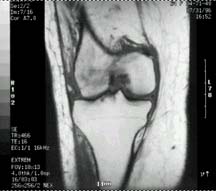
An MRI image of a difficult case from Dr. Randale Sechrest's web site. Dr. Sechrest consulted with members of the orthopedic@weston.com mailing list about this osteonecrosis of the knee patient. Electronic mailing lists appear to be the electronic forum of choice for medical professionals who wish to link their keyboards to the group mind of their colleagues and counterparts outside of their immediate personal contact. Through the use of mailing lists, clinical and research questions are posed, requests for rare information are made, commentary and input on studies in progress are invited, practice techniques are shared, commercial medical products are critiqued, and just about any other kind of information (or non-information) that might be exchanged when a group of people with similar backgrounds are given equal opportunities to be heard.
Mailing lists exist for just about any topic and each varies in scope of membership from only a handful of subscribers to upwards of the thousands. They are used both to enhance communication on a global scale as well as locally between or within medical departments. Some educational institutions use mailing lists for student discussions outside of class time as an adjunct to the traditional educational settings. Although mailing lists are neither difficult nor expensive to set up, an effective list requires an administrator to oversee the list and perform maintenance work.
Usually, mailing lists are "semi-public" environments in which anyone who wants to subscribe to the list can do so. Some lists limit its subscribers to a restricted group who meet a membership criteria. Another distinction between mailing lists is the issue of being moderated versus being an open forum. All e-mail sent to a moderated mailing list needs to be approved for posting by a moderator before being sent to the e-mail addresses of the list's subscribers. Moderated groups are sometimes seen as an option to limit the amount of noise (inappropriate or redundant messages) passed through the list, but also suffer the drawbacks of requiring the frequent attention of the moderator and a slower turnaround on messages.
Unmoderated mailing lists are the rule on the Internet and although they tend to carry more noise in general than their moderated counterparts, they can still be used effectively to communicate when overseen by an active list administrator and self-policed by a core of members who understand and uphold the fundamental societal values of Cyberspace.
Of all forms of electronic "conferencing," mailing lists are the most invasive because all messages are delivered straight to the subscriber's mailbox whether he or she wants to read them or not. In comparison, newsgroups (covered in the following section) and information on web sites need to be accessed willfully. Because mailing lists are somewhat invasive to the subscribers, they're characterized by a lower tolerance to distractions and its members will either self police to enforce its standards or unsubscribe and leave.
An attractive feature about having mailing lists as an alternative for professional consult is that the digital world is never completely out of office. Good mailing lists can offer useful and accurate information to its users from its users. [20] Answers to questions can begin coming back within the hour that the question was posed to the list. It may not be necessary to wait until Monday for crucial input or intrude with potentially invasive phone calls. Of course, it may also be easier for a colleague to ignore your e-mail.
Rapid communications of a time sensitive nature over a large geographical area are best done through mailing lists. The World Health Organization (WHO) uses a mailing list as a complement to its more conventional communicable diseases outbreak reporting channels. Once the subscriber base of over 2000 users on the list receive the message, many will redistribute the WHO alert to other mailing lists and increase proliferation of reports. Mailing lists have allowed outbreak reports to be spread faster than the WHO itself could actually otherwise deliver. [60]
Mailing lists appear to be the tool of choice for group communications on-line. Its successfulness in sustaining group discussions relies on two things. First, mailing lists are merely extensions of e-mail accounts, eliminating the need to learn a new program. Second, because the discussions on mailing lists are delivered straight to a person's mailbox as regular e-mail, the discussions are slightly invasive into his or her on-line routines and require personal attention to either read or delete.
When using mailing lists to communicate, two things need to be remembered. The first is that although the list sometimes will feel like a close knit and private group, the reality is that on most lists, anyone could be a subscriber on the receiving end of your mail. The second is that since mailing lists invade into other people's private mailboxes, being concise and practicing good "netiquette" are doubly important.
Newsgroups would be like public e-mail (if there was such a thing). They are open bulletin boards with designated topics where anyone can leave a message for the everyone else looking at the newsgroup. Newsgroups are similar to mailing lists in that they are both group forums that allow people to communicate through text based messages. The difference is that with newsgroups, the messages are held on a server for open access and do not require specific access requests to read or post messages to. Although access to newsgroups is completely open, a small number of them are moderated in a similar fashion to moderated mailing lists.
...newsgroups are less invasive and its information needs to be retrieved by those who wish to view it. Readers will not automatically receive a 200K image file automatically just because "some bozo" decided to send a full set of pictures to accent the message.One advantage that newsgroups hold over mailing lists is that on the whole, its easier to locate a newsgroup on a certain subject than it is to locate a mailing list on the same subject. Newsgroups are also less invasive. They are purely public environments that allow anyone to read its messages or post messages to its "threads" of discussion, but its open nature also tends to increase the level of chaos in comparison with other group forums. Newsgroups appear to be the hardest hit by the "noise" created by the Internet's rapid growth.
In general, newsgroups appear to be less effective than mailing lists for the purpose of carrying group discussions across the Internet. One of the main reasons is that it requires an extra step to accessing messages from a mailing list and necessitates the need to learn another computer program to access newsgroup messages. Another reason is that because their message environment is so open, noise and "spam" from unscrupulous advertisers are severe detriments to the usefulness of newsgroups.
Like with e-mail programs, current programs used to access newsgroups also allow users to incorporate images or sound into messages. For groups that plan to exchange a lot of images or sound files that are not sensitive in nature, using a newsgroup may be a good option (a web site would be a better one) because image and audio files are often large and takes time to transmit. Since newsgroups are non-invasive into users' private on-line spaces, it's much more acceptable to incorporate multi-media into newsgroup messages. Newsgroup readers will not automatically receive a 200K image file automatically just because "some bozo" decided to send a full set of pictures to accent the message. They will receive it only if they select the message for viewing.
Though the health and medical disciplines have never appeared to find much interest in using newsgroups devoted to its interest areas, newsgroups may be useful for other reasons. Newsgroups are great places to scan for public opinion, esoteric information, or locate a talkative expert on unusual topics. The author of this paper once needed information on one handed fishing techniques for a disabled fisherman. The question was posted to the "rec.sports.fishing" newsgroup and numerous people replied with opinions, stories, and references to more information. Now, news search engines such as DejaNews catalog the contents of the major newsgroups on Usenet, making it easier to find already existing discussions on a vast array of subjects.
Another prominent use for newsgroups are as support groups. There are newsgroup based support groups for eating disorders, depression, panic disorders, and domestic violence just to name a few. Patients with physical illnesses do not often have access to a community of people who share their same fears, thoughts, and depression about their disorder. The Internet can connect otherwise isolated people in need of help with other people who understand their situation. [12, 27, 41] It's not uncommon to see highly intimate interpersonal relationships develop in on-line support groups. [36, 41] Most people feel more comfortable talking about sensitive issues through the relatively anonymous and faceless screen of a keyboard. [12, 36] Disclosure to an understanding and sympathetic ear, might be that first real step to healing.
The very public nature of Usenet may discourage some people from posting messages to its newsgroups. When privacy is a concern, anonymity can be obtained through anonymous re-mailing services that strip identifying information from message headers. Even with safeguards, and especially when posting to a newsgroup, follow the golden rule of posting to the Internet. "Never post anything you wouldn't want to appear on the front page of the New York Times."
Any person with a PPP or SLIP connection to the Internet and a computer manufactured in 1996 or later should be able to access the web. In comparison to the essentially text based mailing lists and newsgroups, the WWW allows for a great degree of flexibility in the way information is presented.The multimedia flexibility of the world wide web has proven itself a very attractive way of presenting information to an audience seeking a specific type of information. The web can support multi-media presentations, medical image libraries, on-line textbooks, patient/practitioner information files, interactive programs, and numerous other applications. It's big drawback is that the web has rightfully earned its dubious nickname of the "World Wide Wait" because standard Internet connections are inadequate to traffic the bandwidth demanding applications of the web. In some places in the world, the wait can be intolerably long.
Web sites seem to be an ideal way to disseminate information in a one to many fashion, but mailing lists and newsgroups seem to be a far better forum for the many to many communication style that make the Internet such a stimulating environment. Among other things, web site based discussions may fizzle because of problems with accessing the WWW, confusing and inconsistent interface design, and the increased effort it takes to give input into a WWW based discussion.
Following sections will discuss some of the numerous uses of the WWW for medicine.